
Your sewer line works hard every single day—and most homeowners never give it a second thought until something goes wrong. The trouble is, sewer line problems rarely show up overnight. They build slowly, leaving small clues you can spot if you know what to look for.

You’re not alone in dealing with this. The U.S. Environmental Protection Agency estimates that 23,000 to 75,000 sanitary sewer overflows happen across the country every year, with blockages, broken lines, and sewer defects among the leading causes.
Catching warning signs early can save you thousands of dollars and protect your home from major damage. In this guide, we’ll walk through the 10 most common signs of sewer damage, what causes them, and what to do next.
If you spot any of these signs at your home in Wyandotte, Monroe, or anywhere in Downriver Michigan, give Thompson Trenchless a call at (313) 488-3834. We can usually tell you what’s going on after a quick sewer camera inspection.
What Does Your Sewer Line Actually Do?
Your sewer line (sometimes called the main sewer line or the lateral line) is the pipe that carries wastewater from your home to the city sewer main—or to your septic tank. Every flush, every shower, every load of laundry sends water through that one pipe.
When it’s working right, you don’t think about it. When it’s failing, you can’t stop thinking about it.
10 Warning Signs of Sewer Line Damage

1. Slow Drains All Over the House
One slow drain usually means a local clog—maybe hair in the bathroom sink or grease in the kitchen. But when multiple drains start running slowly at the same time, that’s a different story.
Slow toilets, slow tubs, and slow sinks all together point to a problem deeper in the system: your main sewer line. The blockage is far enough down that it’s backing up everything above it.

2. Frequent Backups (Especially in the Lowest Drains)
Backups in your basement floor drain, basement toilet, or lowest tub are a classic sign of a main line problem. Water always takes the path of least resistance, so when the main line is blocked or damaged, sewage backs up at the lowest point first.
If you’re calling a plumber every few months for the same clog, the issue probably isn’t really a clog at all. It’s a damaged pipe that keeps catching debris. That’s where professional sewer line repair becomes the long-term fix.
3. Sewer Smell Inside or Outside Your Home
A healthy sewer system is sealed. You shouldn’t smell it at all.
If you catch a rotten-egg or raw-sewage smell in your basement, near a floor drain, in your yard, or coming up through your sinks, that means sewer gas is escaping somewhere it shouldn’t. A cracked pipe, broken seal, or dried-out P-trap can all let it through.
Don’t ignore it. According to the CDC’s Agency for Toxic Substances and Disease Registry (ATSDR), the hydrogen sulfide gas that gives sewer gas its rotten-egg smell can cause headaches, eye irritation, dizziness, and nausea even at low levels, with more serious effects possible at higher concentrations. It’s also flammable. Get the source found and fixed.

4. Gurgling Sounds from Toilets and Drains
Hear a glug-glug or bubble noise when you flush, run the dishwasher, or drain the tub? That’s air trying to escape past water that shouldn’t be there. It means your sewer line isn’t flowing freely.
Gurgling often shows up before backups do. Think of it as your early warning system.

5. Soggy or Unusually Green Patches in Your Yard
Walk around your lawn. Are there spots that stay wet even when it hasn’t rained? Patches of grass that look greener, thicker, or taller than the rest?
That’s because leaking sewage acts like fertilizer. It feeds the grass above it. While that might sound like a happy accident, it’s actually a sign that wastewater is escaping into your yard. Check for soft spots, sinkholes, or a faint smell while you’re out there.
6. Cracks in Your Foundation, Walls, or Driveway
A leaking sewer line under your home can slowly wash away the soil supporting your foundation. Over time, that causes the foundation to shift, settle, and crack.
If you notice new cracks in your foundation, drywall, or slab driveway—especially over an area where your sewer line runs—a leaking pipe could be the cause. This is one of the more expensive signs to ignore, so get it checked early.

7. Mold or Mildew on Walls, Ceilings, or Floors
Sewer pipes don’t have to be soaking your floors to cause mold problems. A small, slow leak adds enough moisture to the air for mold and mildew to take hold on nearby walls, baseboards, or ceilings.
If you’re seeing dark spots, peeling paint, or a musty basement smell with no clear source, your sewer line could be the culprit—especially if it runs nearby.
8. Higher Water Bills with No Lifestyle Change
Has your water bill jumped lately without any obvious reason? No new fixtures, no extra laundry, no leaky faucets you know about?
A cracked sewer or water service line can leak hundreds of gallons before you ever notice. If your bill is creeping up and the other signs on this list sound familiar, the two might be connected.

9. Pest Problems (Rodents, Insects, and Flies)
Rats, mice, cockroaches, and drain flies are drawn to sewage. A cracked sewer pipe gives them an easy path right into your basement or crawlspace.
If you’ve suddenly got a pest problem and can’t figure out where they’re coming from, the sewer line is worth checking. Rats in particular are excellent at finding broken pipes—and they’re hard to get rid of until the pipe is fixed.
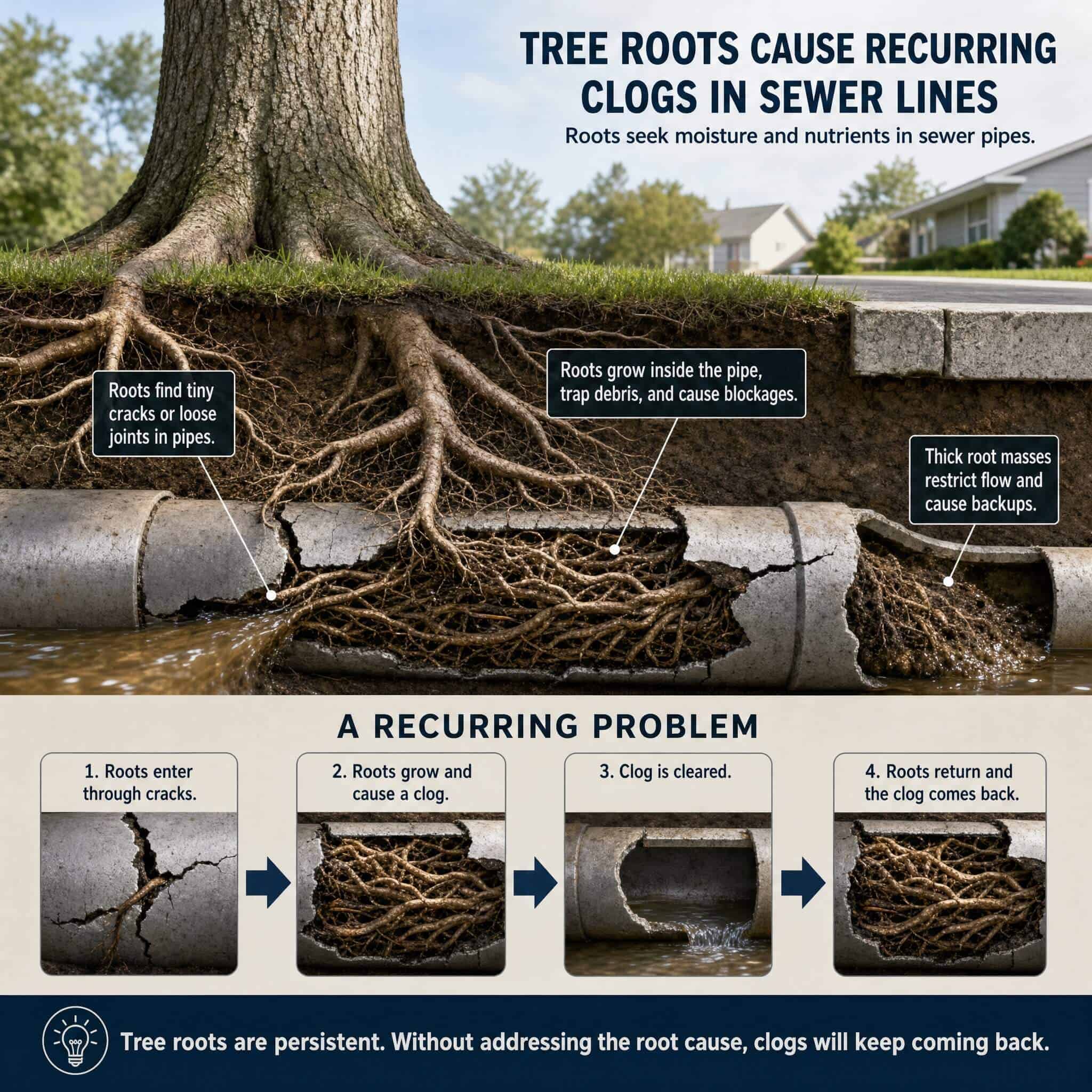
10. Recurring Tree Root Clogs
Tree roots love sewer lines. They sniff out the warm, nutrient-rich water inside and push their way through the smallest cracks. Once they’re in, they keep growing.
If a plumber has snaked tree roots out of your line once, they’ll be back. Cabling clears the clog, but it doesn’t fix the cracked pipe that let them in. For a lasting fix, you need either professional tree root removal plus pipe repair, or a full trenchless sewer repair to seal the line.
What Causes Sewer Line Damage in the First Place?
Most sewer line problems trace back to one of these culprits—many of which the EPA lists as primary causes of sanitary sewer failures:
- Age and material. Cast iron pipes from before 1980 corrode. Clay pipes from earlier eras crack. Orangeburg pipe—a tar-paper product common in mid-century homes—collapses on its own over time.
- Tree roots. The single most common cause of sewer line damage in Michigan homes.
- Ground shifting. Freeze-thaw cycles, heavy clay soil, and settling all stress underground pipes.
- Blockages from grease and “flushable” wipes. They build up, trap solids, and pressure-test weak spots until something gives.
- Poor original installation. Improper slope causes pipes to “belly,” holding water and waste that erode the line over time. That’s where bellied pipe repair comes in.
Older homes in Wyandotte, Monroe, and the Downriver area often have a mix of these issues—especially homes with mature trees and original 1950s-era plumbing.
What to Do If You Spot These Signs
The most important rule: don’t keep snaking the same drain over and over. Cabling can buy you a few months, but it doesn’t fix the underlying damage. Each backup risks property damage, and the problem only gets worse from here.
Here’s a simple plan:
- Stop using the affected fixture if it’s actively backing up. Don’t run dishwashers, washing machines, or showers until it’s cleared.
- Call for a professional camera inspection. A camera shows exactly what’s happening inside your pipe—cracks, root intrusion, bellying, separation, or corrosion. No guessing.
- Get an honest assessment. A good plumber will explain what they saw, where the problem is, and what your real options are. You should never feel pressured into a repair you don’t understand.
- Choose a repair method that fits the damage. Sometimes a simple cleaning with hydro jetting is all you need. Other times, a section of pipe needs lining or replacement.
How Thompson Trenchless Fixes Sewer Line Problems Without Tearing Up Your Yard
In the past, fixing a sewer line meant digging a long trench across your yard, driveway, or basement floor. That’s still how some companies do it. We don’t.
At Thompson Trenchless, we use trenchless sewer repair methods that fix the pipe from the inside:
- pipe lining (CIPP) — We insert a flexible liner into the damaged pipe, then cure it in place. The result is a smooth, seamless new pipe inside the old one, with a 50+ year lifespan. No digging up your driveway.
- pipe bursting — For pipes too damaged to line, we pull a new pipe through the old one, breaking the old pipe outward as we go. Two small access pits replace a 50-foot trench.
- Hydro jetting and rooter service — When the line itself is sound but clogged with roots, grease, or buildup, high-pressure water cleans it fully.
Every job starts with an HD sewer camera inspection so you see exactly what we see. No scare tactics, no guesswork—just honest answers and a real plan.
Frequently Asked Questions
How long does a sewer line typically last?
It depends on the material. Modern PVC pipes can last 100 years. Cast iron usually lasts 50–75 years. Clay pipes last 50–60 years, and Orangeburg pipe often fails within 30–50 years. If your home was built before 1980, your sewer line is likely near or past its expected lifespan.
Can I keep using my sewer line if it’s only “kind of” damaged?
You can, but it gets riskier every month. A small crack today is a major break next year, and small backups become sewage floods. Most homeowners save money in the long run by addressing problems early, when a less invasive repair is still an option.
Will my homeowners insurance cover sewer line repair?
Most standard homeowners policies do not cover sewer line damage or replacement because the line is considered a maintenance item. Some insurers offer a separate “service line” rider that does cover it. Check your policy before assuming you’re covered—and ask your insurer specifically about sewer and water service lines.
Do I need a permit to repair my sewer line?
In most Michigan municipalities, yes. A licensed plumber will pull the right permits and schedule any required inspections. This protects you when you sell the home, since unpermitted work can complicate a sale.
How much does sewer line repair cost?
Costs vary based on the length of damaged pipe, the depth, the type of repair, and access. A spot repair or pipe lining for a short section is far less expensive than a full traditional replacement. The most accurate quote comes after a camera inspection—but trenchless methods almost always cost less than digging once you factor in the cost of restoring your yard, driveway, and landscaping.
How fast can you respond to a sewer emergency in Wyandotte or Monroe?
We offer 24/7 emergency service throughout Wayne and Monroe Counties, with typical response within 2–4 hours. Most emergencies are cleared on the same visit.
Don’t Wait for a Backup to Take Action
If anything on this list sounds familiar—slow drains, smells, soggy lawn, gurgling, recurring clogs—your sewer line is asking for attention. The earlier you catch it, the more options you have and the less it costs.
Schedule a free sewer camera inspection with Thompson Trenchless today. We’ll show you exactly what’s going on inside your pipes, explain your repair options honestly, and only recommend work that’s actually needed.
Call (313) 488-3834 or visit our contact page to schedule. Serving Wyandotte, Monroe, and Downriver Michigan with licensed, master-plumber-led service.
Sources
- U.S. Environmental Protection Agency (EPA). “Sanitary Sewer Overflows (SSOs).” National Pollutant Discharge Elimination System (NPDES). Accessed May 2026.
- U.S. Agency for Toxic Substances and Disease Registry (ATSDR), Centers for Disease Control and Prevention. “Public Health Statement: Hydrogen Sulfide.” Accessed May 2026.